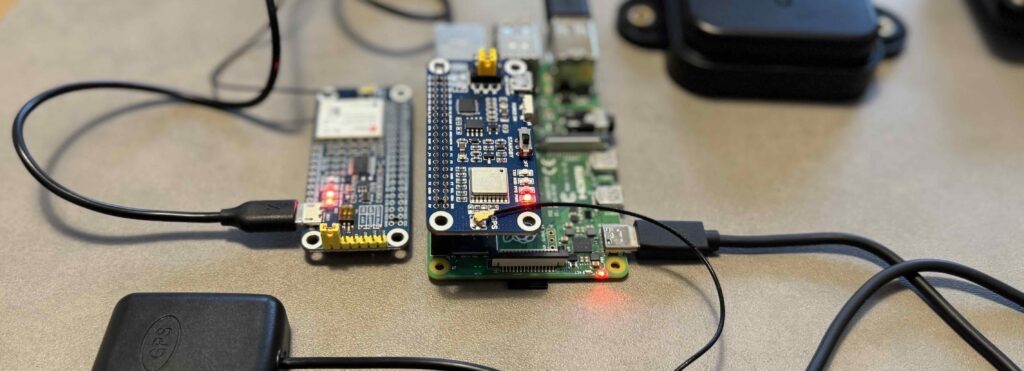
In one of my previous blog posts, I explored how to read live vehicle data through the OBD II port that is present in most (modern) cars. As mentioned in the outlook, the next step in my project is to combine vehicle telemetry with (accurate) positional information in order to enable more advanced analysis. To achieve this, I created a small GNSS test setup. The platform for all experiments is again a Raspberry Pi. For a first comparison, I selected two GNSS boards from Waveshare: the L76X GPS HAT and the ZED F9X GPS RTK HAT.
Why these two modules?
The L76X is an inexpensive entry level device that is suitable for navigation, mapping or general position tracking. It supports GPS and BDS and normally delivers a position accuracy of a few meters. The ZED F9X belongs to a completely different class. It is a multi band GNSS receiver that supports real time kinematic (RTK) processing. When correction data is available, it can reach accuracy in the range of centimeters, which makes it suitable for robotics, surveying, precision agriculture or any application that requires very accurate geolocation data. The antenna systems also show clear differences. The L76X includes a simple single band GPS antenna, while the ZED F9X works together with a multi band active GNSS antenna that allows reception of several frequency ranges at once. This antenna design is essential for achieving the high accuracy that the ZED F9X is capable of.
From the provided software to writing my own scripts
Both modules are delivered with example software and Python scripts on the manufacturer web pages. I tried using these examples first, but outdated Python versions and older code libraries quickly created compatibility problems. Because of this I moved directly to writing my own scripts, which turned out to be the better choice later on. The L76X operates at one update per second in its default configuration, but it can be configured to send up to ten updates per second. The ZED F9X can operate with even higher update rates, in some cases up to twenty five updates per second depending on the selected messages. However, not every communication protocol supports these higher update rates. I started with NMEA, which worked well up to ten updates per second. Above that limit the protocol becomes inefficient because the messages are relatively large. For the ZED F9X, switching to UBX made much more sense because UBX uses compact binary messages. Unfortunately the L76X does not support UBX, which means NMEA remains the only option for that board.
What comes next?
With the hardware and software configured and with automated startup and first measurement routines working reliably, the next step will be real world testing inside a car. In particular, I want to find out how the speed of the vehicle affects the quality of the GNSS measurements, how different surroundings such as hills, forests and tall buildings influence the accuracy, and how big the practical performance gap is between the simple L76X with its basic antenna and the ZED F9X combined with a multi band active antenna.
Leave a Reply